
You can find Newport Lakes here: off Lakes Drive, Newport VIC 3015, Australia
For those travelling by public transport, the park is about a 15 minute walk from Newport Station.
Gates to the public car park open at 8am and close at 7pm, 9pm during daylight savings time.
The park is open to pedestrian at all hours.
🐶 Dogs at Newport Lakes:
Responsible dog owners and their dogs are welcome at Newport Lakes Park. There is plenty of space to walk, play and relax with your dog in designated areas.
Some sensitive parts of the park are closed to dogs completely. These conservation areas, like the lakes, form a valuable sanctuary for wildlife and native plants. Please keep a lookout for signage.
Dogs can cause excessive stress in wildlife by chasing, barking and attacking them; please protect wildlife from your dog.
Reduce the risk to your pet from snakes. Snakes are present at Newport Lakes and a bite can be fatal.
Take a tour and find out what Newport Lakes Park has to offer:
Bird Trails
The following describes four trails around Newport Lakes that use bird mosaics as markers.
This special place inspired Linda Cottrell, a local artist and committee member in the Friends of Newport Lakes at the time, to devise four trails featuring resident bird life on mosaics designed and constructed with the help of local residents and students from Newport Lakes Primary School, Spotswood Primary School and Bayside Secondary College. Trail 2 features a bird hide constructed and painted by members of the Friends of Newport Lakes in 2000. Over 180 different bird species have now been recorded in the park and more new species are still being seen.
Credits:
Directing Artist: Linda Cottrell.
Mosaic Teacher (including use of equipment): Libby McKinnin.
Stone Mason: David Waters.
Bird Hide Builders: Ted Peck with Ron Bowman, Mary Burbidge, Linda Cottrell, Ray Rodwell and other Friends.
Tiles provided by: Hynes Tiles, Williamstown and Geelong Road.
Funds provided by: Hobsons Bay City Council Community Grant, 1999.
Text by: Sarah Berry, revised by Mary Burbidge in 2012.
New mosaics designed and installed by Julee Latimer and funded by Friends of Newport Lakes in 2009-10.

General instructions for using the trails
Look carefully for the mosaics, they may not be immediately obvious. There are eight mosaics all together, but you won’t see all of them on one trail. In between the mosaics, follow the Willy Wagtail directional signs marked with a trail number, either 1, 2, 3 or 4.

The trails range in length between 1200 and 2100 metres, taking between 25 and 40 minutes to complete. Some pathways in the park are steep and covered with recycled concrete gravel. They may be slippery and unsuitable for visitors with mobility difficulties. To avoid damaging plants and encountering snakes, do not venture into tall grass or bushland. If you spot any vandalism please report it to Hobsons Bay City Council on 1300 179 944 during business hours or otherwise contact Victoria Police.
All trails begin with the Purple Swamp Hen mosaic inside the conservation area and to the left of the main entrance.
Bird Trail 1:
(1200 metres, 25 minutes) Map symbol: blue dashed line


- From the Purple Swamp Hen, go left and down hill. Look for a Willy Wagtail 1 Marker before a second lookout. Turn left, walking around the top of the Amphitheatre.
- Find the Bell Frog mosaic and walk down slope into the Amphitheatre. Walk across the Amphitheatre and the bridge.
- Cross the stepping-stones and look for the Dusky Moorhen mosaic.
- Turn right and follow the lakeside path around South Lake, past the Black Swan and up hill to the Purple Swamp Hen.
Bird Trail 2:
(600 metres, 35 minutes) Map symbol: purple dashed line
- From the Purple Swamp Hen, go left and down hill to the stepping- stones. Cross the stones and look for the Dusky Moorhen mosaic. Follow Willy Wagtail 2 Markers left around North Lake where you’ll pass Crake’s Corner mosaic.
- Follow the lakeside track around the lake and uphill. On your left, you’ll find the bird hide built in 2000 by the Friends of Newport Lakes. Cross the little bridge on your left.
- Follow this track and you’ll pass the Galah and Lorikeet mosaic on your left. Follow the track left to the Amphitheatre. At the Bell Frog mosaic walk down slope into the Amphitheatre.
- Walk across the Amphitheatre and the bridge. Cross the stepping-stones again and turn right following the Willy Wagtail 1 Markers. Follow the lakeside path around South Lake, past the Black Swan and up hill to the Purple Swamp Hen.

Bird Trail 3:
(1400 metres, 30 minutes) Map symbol: green line


- From the Purple Swamp Hen, turn right down hill to the Black Swan. Walk halfway up the steep slope where you’ll see a Willy Wagtail 3 Marker.
- Turn left and follow the track at the base of the cliff. Along the way, you’ll see the New Holland Honey Eater and Fairy Wren mosaic. Cross over the grassy picnic area and pick up the track at the base of the cliff again.
- Pass the Rainbow Lorikeet mosaic, walk down the steps and cross the little bridge ahead of you. Follow this track and you’ll pass the Galah and Lorikeet mosaic on your left. Follow the track and the Willy Wagtail 3 Markers left to the Amphitheatre.
- At the Amphitheatre, find the Bell Frog, look for a Willy Wagtail 3 Marker, and follow the track around the top of the Amphitheatre. At the Amphitheatre Lookout, turn right and walk up hill back to the Purple Swamp Hen.
Bird Trail 4:
(2100 metres, 40 minutes) Map symbol: orange line
- From the Purple Swamp Hen, turn right down hill to the Black Swan. Go to the top of the steep slope to the boundary fence and follow it round to the left.
- Follow this track around the perimeter of the park. It takes you past the South and then North Lake, passes the new native wildflower bed next to the native display garden and continues around the back of the North-West plain area and past the Arboretum to the paved road.
- Look for a Willy Wagtail 4 Marker on your left directing you towards the Lakes. At the Amphitheatre, find the Bell Frog, look for a Willy Wagtail 4 Marker, and follow the track around the top of the Amphitheatre.
- At the Amphitheatre Lookout, turn right and walk up hill back to the Purple Swamp Hen.


North and South Lakes
Bull rushes surround the lakes while banks and slopes are planted with gums and wattles. The larger trees planted in the 1980s, include yellow box, black wattle, sheoak and hemp bush. Some of the oldest trees, at the park’s edges have possum boxes.
The water is much shallower here than the body of the lake, a deliberate safety feature by the park’s designer, and, as the birds swim through the stones, you’ll see that really there is only one lake. The water level of the lake is maintained through the addition of bore water.
In spring you might see islands of sticks in the shallower water, these are the nests of the Australian Coot and Dusky Moorhen.

At the far end of North Lake you’ll see a group of dead trees in the water. These were deliberately ‘planted’ to be roosts for Cormorants and other large birds.
The lake is home to a breeding pair of black swans. Each year they lay two to three clutches of six eggs. Unlike Cherry Lake in Altona and The Esplanade in Williamstown, these swans are territorial, so they’re the only pair of swans you’ll see here.
We’ve seen Cormorants catch small Carp, but we don’t think there are many fish as the water is shallow and in summer it may not contain enough oxygen. However, you may see Yabbies, Water Rats and Water Boatmen and, possibly, Turtles. Growling Swamp Frogs hide in the bull rushes, they are often heard, but rarely seen.
You’ll find three tracks in this area: lakeside, cliff-bottom and cliff-top that can be taken individually for gentle walks or combined for substantial exercise. Each track offers different views; take the cliff-bottom track and you may believe you are deep in the bush.
There are picnic tables on the slopes above both lakes and a simple Bird Hide lakeside of North Lake.
Amphitheatre
Like the rest of the park, this area was once a quarry.


The quarry work left a bluestone cliff that surrounds the circular area. After rain, you may see a waterfall if the swamp above the amphitheatre is full.
In the centre of the Amphitheatre, you’ll see a metal box. This contains a pump to draw up water through a bore into the ground water 200 metres below the surface. This water maintains the water level of all the lakes. When the water reaches the surface, it enters the small perimeter lakes. The park designer called these ‘feeder lakes’ because bore water filters through these lakes, improving its quality, before it reaches North and South Lake.
The common plants in this area include: the Bull Rush, Thin Duck Weed, Combugi, Sedges, Common Mardoo, Water Button and bush tomatoes.
The most obvious bird in the Amphitheatre is the Purple Swamp Hen, a black hen-like bird with a purple breast and large feet.
The amphitheatre has been extensively replanted with native plants and a deck has been installed to overcome bank erosion.
The amphitheatre makes a wonderful setting for the annual Newport Fiddle and Folk Bush Dance.
Arboretum
An Arboretum is a collection of exotic plant species.


The Arboretum was one of the first areas to be redeveloped from a quarry in the 1970’s. The councils of the time funded unemployed people to plant the area. It wasn’t until September 1997, after pressure by the Friends that the surrounding fences were taken down by Council. Before that residents would cut holes for access.
In 2000, seating and entry paths were added to the area, and in 2013 a bridge across the swale was built to improve the amenity for walkers.
Many new plants from various parts of Australia have been added to the arboretum to increase its rich diversity and the Friends of Newport Lakes have funded the labelling of some specimen trees.


Pavey’s Park

In the early decades of the twentieth century this area was a quarry called, Pavey’s Hole, after its owner. This area was used as a tip after the quarry was worked out and then redeveloped as a park. It now is made up of a Ranger’s workshed, Newport Lakes Native Nursery, a car park, BBQ facilities and picnic shelters, a playground, paths and a large grassy open area. The electric BBQs are free to use.
North West Plain 🐶
This large flat area remains relatively undeveloped. It was once one of the biggest quarries in the park and then a Council tip in the 1980s. The tip was capped in layers of clay to seal in the decomposing rubbish and the resulting gasses. It is often the home of many weeds (and a source of weed seeds that blow into the rest of the park), but a grassland of sorts with its own bird community is developing.
What will happen to this area? There are no definite plans as yet. Many suggestions have been made including more forest, more open park, native grassland, community allotments and a viewing mound or platform.
In the meantime, scattered trees are growing gradually and more are being planted. The area is a popular off-leash area for exercising dogs.

Map of Newport Lakes Park
Mosaic Map Legend
The eight blue numbered circles on the map above mark the bird-trail mosaics around Newport Lakes. Use this guide to identify each mosaic and the feature beside it.
Purple Swamphen Mosaic
Point of interest: Each year up to 5,000 trees, shrubs and grasses are planted in the Newport Lakes park. The rangers work from a plan to know what local species to plant and where. All these seedlings are watered by hand until they establish — that’s a lot of work and only one of the rangers’ many tasks.
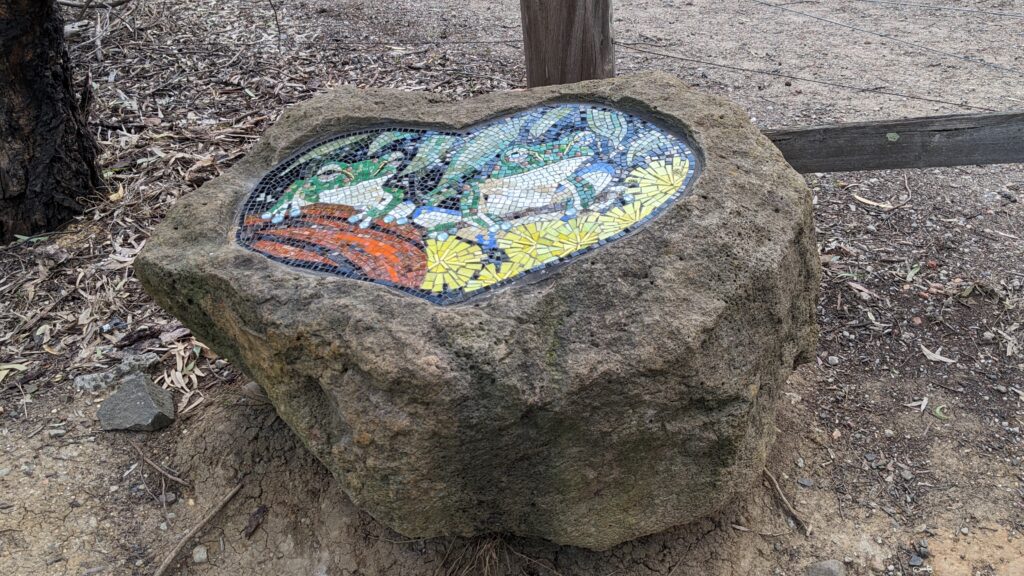
Bell Frog Mosaic
Point of interest: The amphitheatre is not a natural feature but the shape of the former bluestone quarry. In wet times there is a waterfall over the side of the cliff. The park’s designer laid pipes to collect storm water from the western edge of the park to form this feature. In the centre of the amphitheatre, partially hidden by vegetation, you’ll see a metal box — this is the bore that draws water up 120 metres from an underground aquifer to supply the lakes and keep them topped up. When you cross the stepping-stones, look for metal poles on either side; the ranger uses these as a gauge to turn the bore on, but there is a limit to the volume that can be taken.
Galah and Rainbow Lorikeet Mosaic
Point of interest: To the west of this area of young forest are two contrasting areas. To the north there is an open area and, to the south, the arboretum. The open North West Plain, once a large quarry, was used as a tip until the end of the 1980s. It was then capped with clay and has been lightly planted with eucalypts, but its final use within the park is still to be decided. The arboretum was the first area of the park to be developed, in the 1970s. An arboretum is like a botanical garden and contains trees from other countries — a good collection of prostrate conifers and a wide range of exotic trees and shrubs, as well as native plants from other parts of Australia.
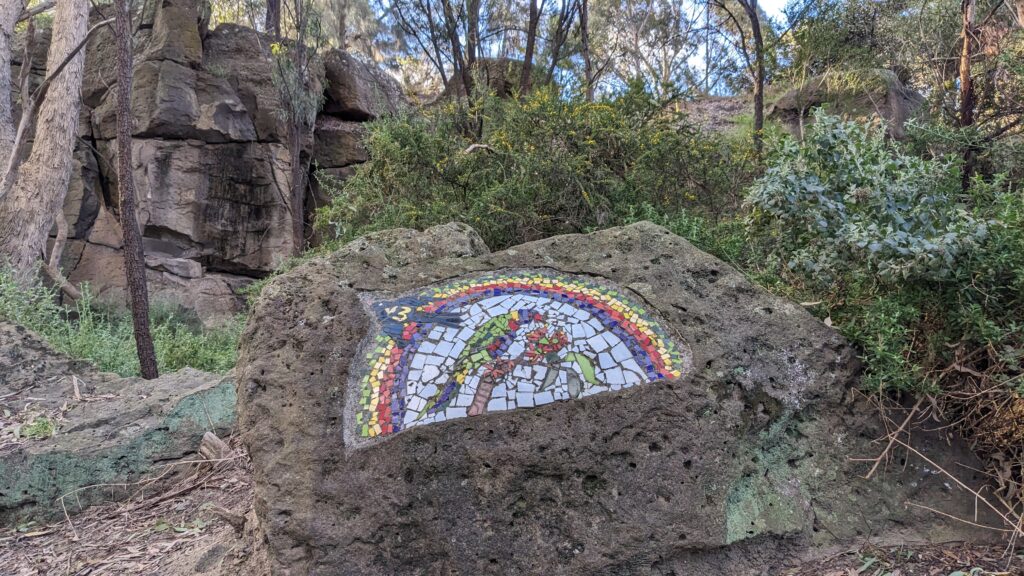
Rainbow Lorikeet Mosaic
Point of interest: Virtually all land between here and South Australia was formed in volcanic eruptions four and a half million years ago. Eruptions occurred as recently as four thousand years ago. The lava cooled to form a dense rock called basalt, also called bluestone, over which a thin clay soil slowly accumulated. For thousands of years this area was flat grassland scattered with bluestone. These were Bunjil or Eagle Clan lands, and the park site was once an ancient hill used by the local tribes.
Crake’s Corner Mosaic
Point of interest: At the stepping-stones and in the lakeside area, ducks and other water birds may approach you looking for food. Please do not feed the birds — birds can be harmed by eating, looking for food. Please do not feed the birds — birds can be harmed by eating, and becoming dependent on, non-natural food. The nutrients from their droppings and from uneaten food help to create blooms of algae in summer. These are not only unattractive but take oxygen from the water and can be toxic.
New Holland Honeyeater & Superb Fairy-wren Mosaic
Point of interest: The cliffs form the main feature of this forested trail, however they are not a natural feature but were formed as the area was quarried for bluestone between 1885 and 1968. Up to 300 tradespeople were employed here. The stone provided ballast for ships returning to Europe and building material in Melbourne. Locally, stone was used in roads, gutters, the Williamstown sea wall and a freezing plant (now demolished).
Dusky Moorhen and Frog Mosaic
Point of interest: If you go back to the lakeside and look to your right, you’ll see a group of dead trees. These are a favourite perch for darters and cormorants. The park designer ‘planted’ these trees for birds as well as fitting the stepping-stones. The stepping-stones were made possible by raising the adjacent lake bed as a safety measure (if you look either side, you can see how shallow the water is). The park’s cliffs have been sculpted and stabilised as another safety measure.
Black Swan Mosaic
Point of interest: One of the greatest challenges for visitors, local residents, the Friends and the Council is the difficulty in combining different uses of the park. In order for the lakes area to provide a sanctuary for waterbirds, dogs are not allowed in the North and South Lakes or the amphitheatre. However, dogs are allowed in the western half of the park.
Our Mosaics
Bird Trail Mosaics
The eight mosaics are used as markers in the four different bird trails around Newport Lakes. See map above.
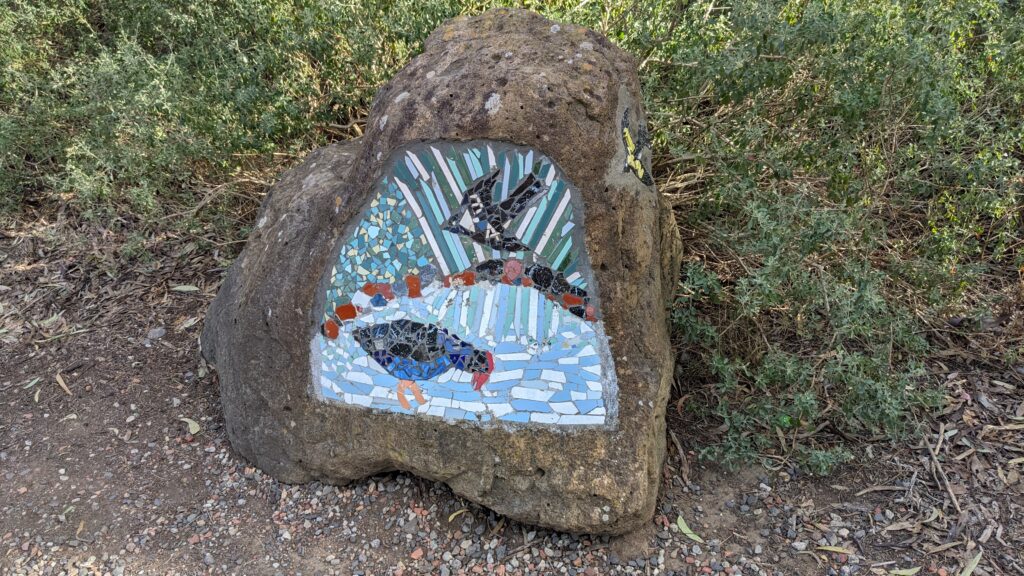
1. Purple Swamphen Mosaic
Bird Facts: Swamphen eggs are creamy-brown with purple brown sports laid in nests of reed. Swamphens can swim but rarely do. They use their feet to eat grass, aquatiq plants and molluscs.
Surrounding Species: Fragant saltbush (Rhagodia parabolica), Wallaby grass (Danthonia spp).
2. Bell Frog Mosaic
The original mosaic was damaged by vandals and weather. In 2009 a new mosaic was designed and installed by Julee Latimer.
Frog Facts: The Southern Bell Frog (Litoria raniformis), also known as the Growling Grass Frog, can change from green to brown in 10 minutes, depending on environmental conditions.
Surrounding Species: Red Gum (Eucalyptus
camaldulensis), She-Oak (Allocasuarinsa verticillata), Tussock Grass (Poa labillardierii), Red Ironbark (Eucalyptus
sideroxlyon).
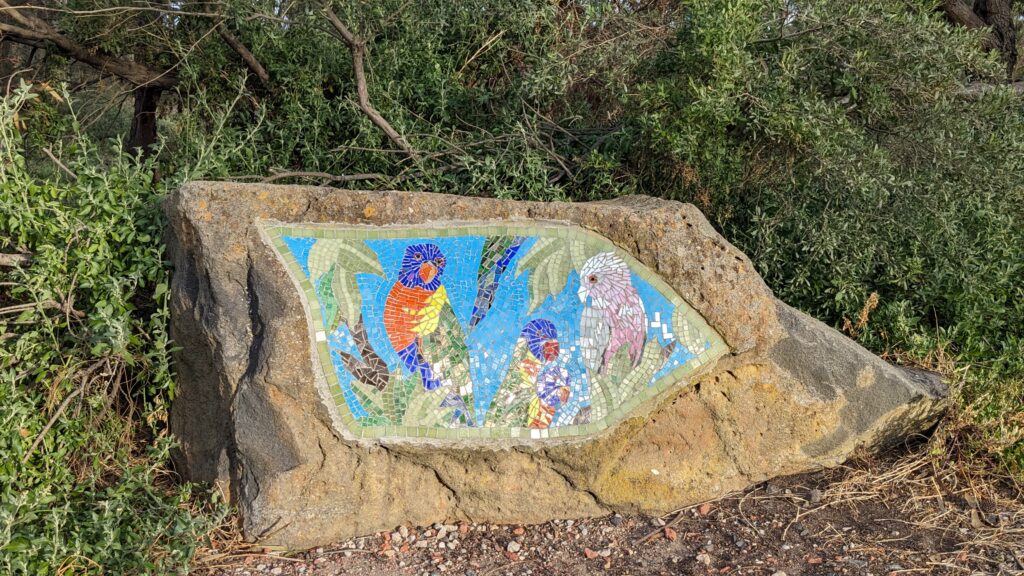
3. Galah and Rainbow Lorikeet Mosaic
This new mosaic replaces the old Magpie Mosaic which was damaged beyond repair. It was designed and installed by Julee Latimer in 2010.
Bird Facts: Lorikeets have feathery tongues for absorbing nectar deep in blossoms. The brillliant Rainbow Lorikeet is the most easily seen and heard.
Smaller Musk, Little and Purple Lorikeets are also sometimes heard or seen in blossoming eucalypts in the park. Galahs are also bright and noisy and can be seen eating seed on the ground or in trees. Other parrots, including large Yellow-tailed Black Cockatoos which feast on pine cones, are less common visitors.
4. Rainbow Lorikeet Mosaic
Bird Facts: This is largest, brightest and noisiest of the lorikeets; they feed in chattering, squabbling groups in the tops of blossom-laden trees. They have hairy tongues to collect nectar from blossom. They nest in tree holes so they can only use old trees for their homes.
Surrounding Species: Hedge Wattle (Acacia paradoxa), Black Wattle (Acacia) and Greybox (Eucalyptus microcarpa).
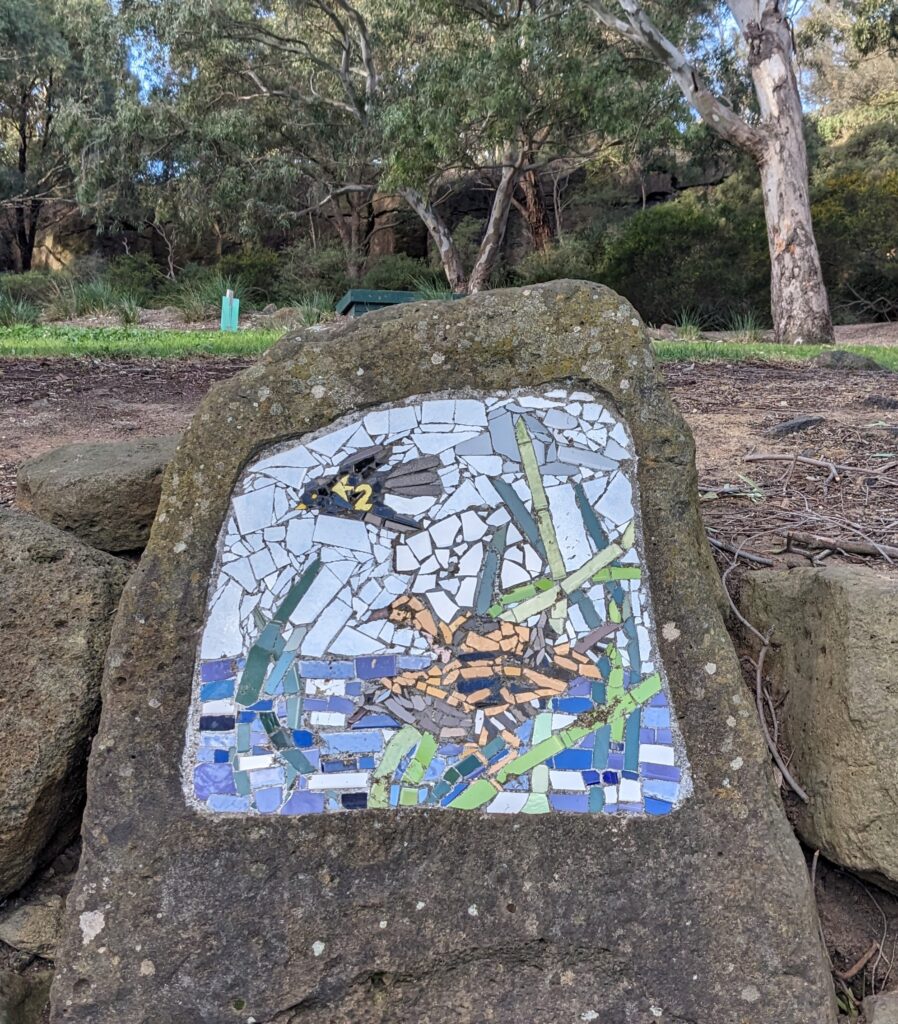
5. Crake’s Corner Mosaic
Bird Fact: Crakes are shy birds that are difficult to see before they disappear into the reeds. They feed on aquatic insects and plants and nest at the base of grass tussocks
in the water.
Surrounding Species: Common Reed (Phragmites australis), Wirilda Wattle (Acacia retinoides).
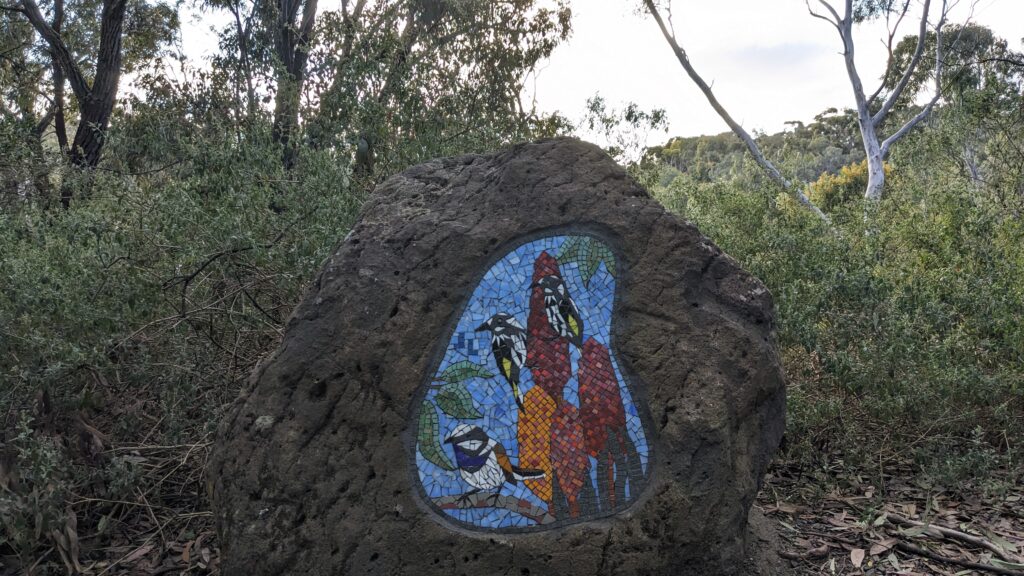
6. New Holland Honeyeater & Superb Fairy-wren Mosaic
Bird Fact: These honeyeaters are a common sight in this park; listen for their sharp, shrill call and watch for their acrobatic flight displays. They eat insects and nectar
and nest in cup-shaped nests 1-2 metres off the ground.
Fairy-wrens live in cooperative family groups of females, young and one bright blue male. They build dome-shaped nests in shrubs or grass near the ground. Young birds and adult females are both brown. Listen for their pretty, reeling song.
Surrounding Species: Lightwood Wattle (Acacia implexa), Red Ironbark (Eucalyptus sideroxylon).
7. Dusky Moorhen and Frog Mosaic
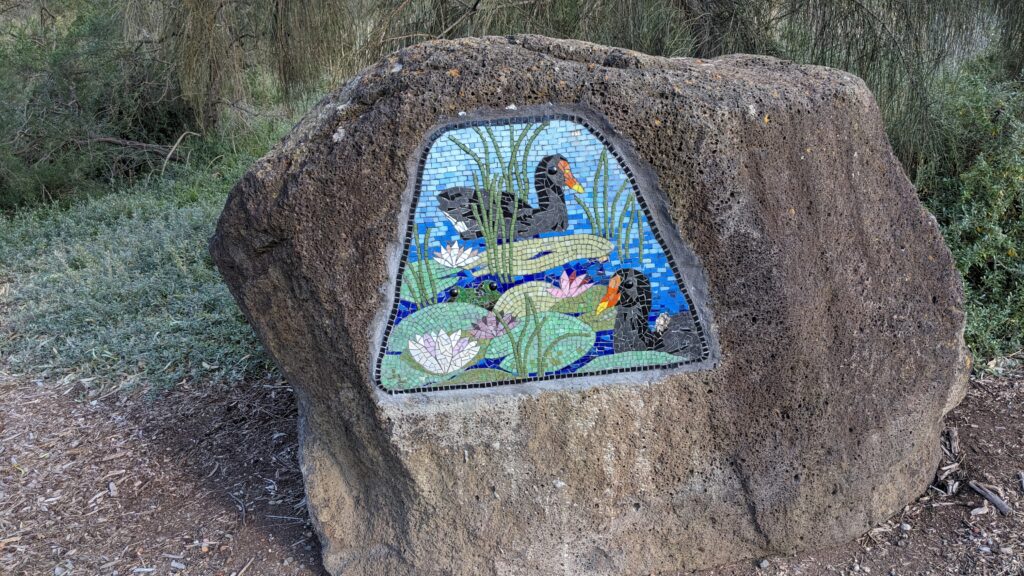
Bird Facts: Dusky Moorhens are common residents of the lakes, nesting in groups on a platform deep in the reed beds and sharing the care of their chicks. The mosaic shows their distinctive red facial shield and yellow-tipped bill. Look for the characteristic white tail patches as they flick thier tails or dip into shallow water for food.
The presence of frogs is a good indicator of the health of an ecosystem such as the lakes.
Surrounding Species: Blue Gum (Eucalyptus globulus), River Red Gum (Eucalyptus camaldulensis).
8. Black Swan Mosaic
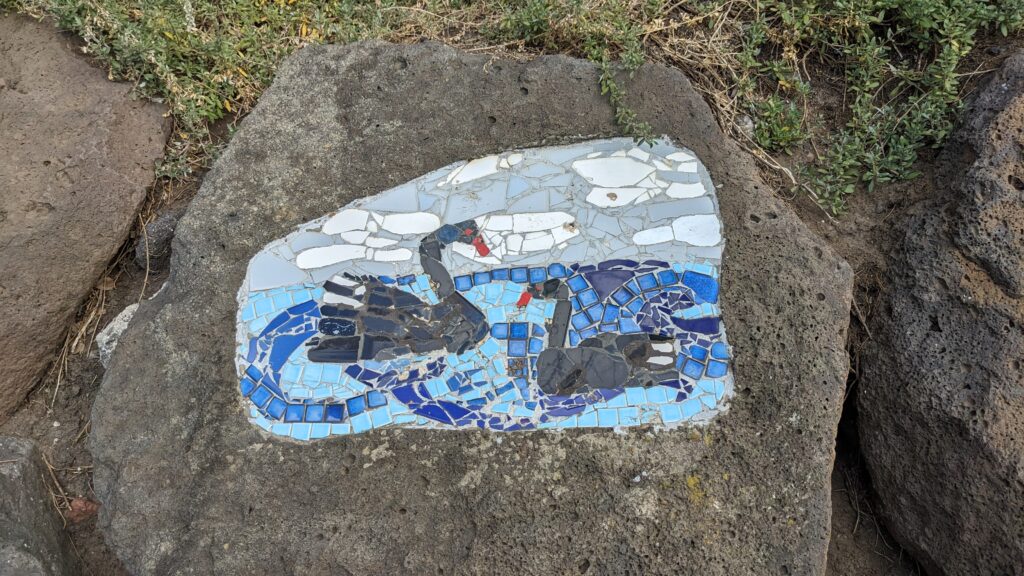
Bird Fact: Swans mate for life and make their grass and reed nests on the island in the middle of the Lakes. Swan eggs are green. Swans eat aquatic plants and animals and a swan call sounds like a trumpet.
Surrounding Species: Black Wattle (Acacia mearnsii), Coast saltbush (Atriplex cineria), River She-Oak (Allocasuarina cunninghamiana).
Fauna List


Over 150 species of birds have been recorded in the park, from birds of prey such as the Black-shouldered Kite to lorikeets and wetland birds like grebe and cormorants. Such a variety of birds is possible because the park provides a wealth of diverse habitats and safe areas to rest and feed.
The lakes are home to many frogs, lizards, turtles, bats, possums and snakes. In 2011, a tiny Hopping Mouse was sighted.
The council is hoping to attract possums out of neighbourhood roofs and into the park! Rescued animals are also released in carefully sited boxes by Wildlife Rescue services.


Since 1986 records of bird sightings have been recorded extensively by Mary Burbidge:
Birds of Newport Lakes |
Flora List
Some interesting specimens to discover in the Arboretum:


List of native flora originally planted in the park:
Newport Lakes Plant list |